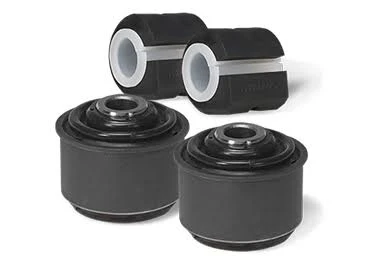
Ningbo Zhonggao Rubber & Plastic Manufacturing Co., Ltd. is one of the most reliable manufacturers and suppliers of automotive rubber mounts in China. The company has world-leading production equipment and strong manufacturing capabilities. Welcome to wholesale custom made automotive rubber mounts from our factory.
Automotive Rubber Mounts
Rubber-to-Metal Mounting Components for Powertrain Support and Vibration Control
Rubber-to-Metal Bonding
A bonded rubber-to-metal construction combines the elasticity of rubber with the strength of metal inserts, while proper surface preparation, bonding coverage, and adhesion control help prevent separation under repeated loading.
Vibration Isolation
Rubber height, wall thickness, void design, and contact areas determine how a mount deforms under load and controls vibration transfer, with dynamic stiffness, damping, and vibration transmissibility testing used to assess its response.
Rubber Material Selection
NBR, HNBR, EPDM, CR, FKM, and VMQ offer different levels of resistance to oil, heat, and environmental exposure, so compound selection should reflect the mount's actual operating temperature, fluid contact, and mechanical demands.
Fatigue Resistance
The rubber section must withstand repeated compression, shear, and torsional movement without cracking or excessive permanent deformation, making fatigue resistance and compression set important considerations when evaluating long-term mount performance.
Product Specifications
|
Parameter |
Specification / Reference |
|
EPDM Operating Temperature |
Conventional automotive rubber parts: -50°C to +150°C; selected new energy vehicle component applications: -70°C to +220°C* |
|
NBR Operating Temperature |
Conventional automotive rubber parts: -50℃ to +150℃ |
|
HNBR Operating Temperature |
Conventional automotive rubber parts & powertrain components: -50℃ to +150℃ |
|
NR Operating Temperature |
-50℃ to +80℃ |
|
CR Operating Temperature |
-40℃ to +120℃ |
|
Rubber Hardness |
50–80 Shore A |
Automotive Applications & Mount Configurations
Mounting requirements vary across vehicle platforms and powertrain layouts, so the rubber compound, mounting geometry, metal inserts, and stiffness characteristics need to suit the component's actual position and operating conditions.
Engine Mounts
Engine mounts used in passenger cars, SUVs, light commercial vehicles, and heavy-duty trucks must support engine weight while limiting vibration and excessive movement, with rubber hardness, geometry, metal inserts, and dynamic stiffness selected according to the engine and mounting layout.
Transmission Mounts
Transmission mounts in passenger vehicles, commercial vehicles, and off-highway equipment accommodate gearbox weight, torque reactions, and movement during gear changes, requiring suitable rubber hardness, structural thickness, bonding areas, and mounting dimensions.
Torque Strut Mounts
Commonly used in front-wheel-drive vehicles with transverse-mounted engines, torque strut mounts help control powertrain movement during acceleration, deceleration, and gear changes, with reinforced rubber sections and metal connections designed around the expected torque reactions.
Custom Powertrain Mounts
Hybrid vehicles, electric vehicles, and conventional powertrains can require different mounting arrangements to accommodate component weight, available installation space, and vibration characteristics, making custom rubber compounds, metal structures, dimensions, and stiffness targets relevant to vehicle-specific development.
Custom Development, Manufacturing & Order Fulfillment
From initial drawings and material selection to molding, inspection, and export delivery, we coordinate the key production stages required to manufacture custom automotive rubber mounts according to customer specifications.
By Drawings, Samples & Mounting Requirements: Custom Development
We can develop custom rubber components from customer drawings or physical samples, assessing rubber compounds, component dimensions, metal insert structures, bonding areas, and mold requirements before sample production.
Rubber Molding & Metal Bonding: Automotive Mount Production
Production involves rubber compound preparation, metal insert processing, bonding-agent application, molding, vulcanization, and finishing, with the specific process selected according to the mount's structure and material requirements.
Dimensional, Material & Bonding: Quality Control
Inspection focuses on rubber hardness, component dimensions, metal insert positioning, bonding integrity, surface defects, and other drawing-specific requirements, with material and finished-product checks conducted throughout production to help maintain batch consistency.
Sample Approval, Bulk Production & Export Delivery
After sample evaluation and specification confirmation, we arrange bulk production, finished-product inspection, packaging, and export shipping according to the order quantity and destination, with sample and production schedules, warranty conditions, and EXW, FOB, CFR, or CIF terms confirmed for each order.
FAQ
Q: Can You Manufacture Replacement Automotive Rubber Mounts for Discontinued Vehicle Models?
A: We can review physical samples, drawings, or dimensional information to assess whether a replacement mount can be developed, subject to the component's structure and manufacturing feasibility.
Q: Can You Use Customer-Supplied Molds for Rubber Mount Production?
A: Customer-supplied molds can be evaluated for compatibility with the required rubber compound, component design, molding process, and available production equipment before an order is accepted.
Q: Can You Arrange Performance Testing for Custom Automotive Rubber Mounts?
A: Required tests can be discussed according to the project specifications, with available in-house inspection capabilities and any additional testing arrangements confirmed before production.
Q: What Is the MOQ for Custom Automotive Rubber Mounts?
A: The minimum order quantity depends on the component design, rubber compound, tooling requirements, and production arrangements, so buyers should confirm the MOQ when submitting their project details.
Q: How Long Does Sample Development and Bulk Production Take?
A: Sample production typically takes 3–15 days, while regular bulk production generally takes 10–30 days after the specifications, tooling arrangements, and order details have been confirmed.
Q: What Warranty Do You Provide for Automotive Rubber Mounts?
A: We provides a 1-year quality guarantee, with the applicable coverage, conditions, and after-sales responsibilities confirmed in the order agreement.
Q: What Information Should I Provide When Requesting a Custom Rubber Mount Quote?
A: Provide the component drawing or physical sample, intended vehicle or powertrain application, rubber material preference, mounting dimensions, estimated order quantity, destination, and expected delivery schedule to help assess the project.
Hot Tags: automotive rubber mounts, China automotive rubber mounts manufacturers, suppliers, axle boot torn, boot steering, car door rubber seal installation, car foot pedal rubbers, car tire inner tube, fire ring head gasket