


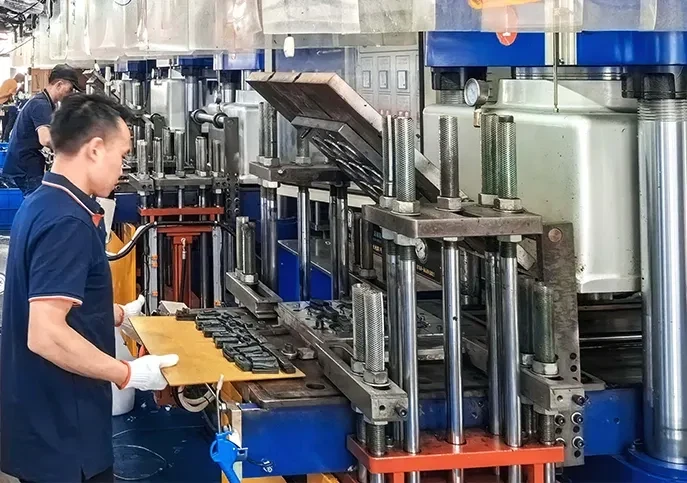
Ningbo Zhonggao Rubber & Plastic Manufacturing Co., Ltd. is one of the most reliable manufacturers and suppliers of cv boots in China. The company has world-leading production equipment and strong manufacturing capabilities. Welcome to wholesale custom made cv boots from our factory.
CV Boots for Reliable CV Joint Protection and Replacement
CV boots are engineered to match specific CV joint and shaft dimensions while accommodating repeated articulation, rotation, and operating temperature changes. Proper material selection, bellows geometry, and secure sealing help protect CV joints from grease loss and contamination while reducing fitment, failure, and replacement risks.
Technical Specifications
Rubber Material Selection:
|
Rubber Material |
Key Performance |
|
NBR |
Fuel Resistance & Hydraulic System Compatibility |
|
Silicone (VMQ) |
Wide Temperature Range & Food-Grade Options |
|
Neoprene (CR) |
Aging Resistance & Flame Retardancy |
CV Boot Specifications:
|
Specification |
Technical Parameters |
|
Product Type |
Inner CV Boot / Outer CV Boot |
|
Material |
NBR / Silicone (VMQ) / Neoprene (CR) |
|
Temperature Range |
NBR: -40°C to +120°C*; Silicone (VMQ): -70°C to +220°C; Neoprene (CR): -40°C to +120°C* |
|
Hardness |
30–90 Shore A* |
|
Small-End ID |
15–40 mm* |
|
Large-End ID |
60–120 mm* |
|
Overall Boot Length |
70–180 mm* |
|
Wall Thickness |
1.5–4.0 mm* |
|
Bellows Convolutions |
3–8 folds* |
|
Elongation at Break |
≥200%* |
|
Compression Set |
≤20% at 70°C × 22 h* |
|
Clamp Width |
5–10 mm* |
|
Mold Accuracy |
±0.01 mm |
*Final CV boot dimensions, material properties, and performance requirements should be verified against the specific CV joint, shaft, operating conditions, approved drawing, or sample before production.
Custom CV Boots
We manufacture custom CV boots based on your CV joint, shaft dimensions, operating conditions, and application requirements.
Material & Hardness
CV boots can be produced using:
- NBR for applications requiring oil resistance
- Silicone (VMQ) for high- and low-temperature applications
- Neoprene (CR) for oil, ozone, and aging resistance
Material and hardness can be selected according to:
- Operating temperature
- Grease or fluid contact
- Required flexibility
- Repeated joint movement
- Sealing and installation conditions
Dimensions & Bellows Geometry
We can produce CV boots with customized:
- Small-end ID, large-end ID, overall length, and wall thickness
- Bellows diameter and number of folds
- Shaft and CV joint fitment dimensions
- Mounting areas, sealing lips, and end profiles
- Holes, grooves, and other required features
Dimensions can be developed from your approved drawing, sample, or specified CV joint and shaft requirements.
Clamps & Sealing Configuration
The boot configuration can be matched to your installation requirements, including:
- Small-end and large-end clamp positions
- Clamp width and applicable fastening method
- Sealing interfaces at the shaft and CV joint
- Boot-only or boot-and-clamp supply
- Complete CV boot kit configuration when required
Drawing / Sample
You can provide:
- CAD or technical drawings
- Critical dimensions and tolerances
- Existing CV boot samples
- CV joint and shaft dimensions
- Material, hardness, and operating requirements
We can use these details to evaluate fitment and develop the required CV boot specification.
Mold & Production
Custom molds can be developed for molded CV boots based on the approved design. Available production capabilities include:
- Custom mold design and manufacturing
- Rubber molding
- Precision cutting and secondary processing
- Sample production for fitment and approval
- Mass production after sample confirmation
For customer-provided molds, OEM production can be arranged according to the approved specifications.
OEM Service
We support custom:
- Dimensions and bellows geometry
- Material and hardness
- Clamps and kit configuration
- Packaging and labels
- Part numbers and identification
- OEM production with customer-provided molds
For customer-provided molds, the customer's project holds the exclusive right to use the molds, while Zhonggao maintains confidentiality to protect customer drawings and intellectual property.
CV Boot Applications
CV boots are used where constant velocity joints require protection from external contamination while retaining lubricating grease during repeated shaft movement.
- Passenger Vehicles
- Commercial Vehicles
- Off-road Vehicles
- Replacement Automotive Parts
- CV Joint Repair & Maintenance
- OEM Automotive Component Programs
CV Boot Manufacutring
For recurring CV boot procurement, supplier evaluation should go beyond the first approved sample.
- Automotive Quality Management
- Tooling & Development Capability
- Production & Inspection
- OEM & Repeat Supply
- Sample Development
Before approving a CV boot sample, supplier should help buyers verify the points that directly affect fitment, sealing, movement, and production repeatability, including dimensions, material selection, fitment, movement, sealing and appearance conditions, and identification.
Zhonggao supports prototype development, short-term production, and large-volume CV boot orders through 20 production lines and a monthly production capacity of up to 10 million rubber parts. Production quantities such as 5,000, 50,000, or 500,000 pieces can be reviewed according to gasket design, tooling, material, and production schedule.
CV Boot Quality Control

-
Drawing & Specification Control
The approved drawing or sample can define the critical dimensions, tolerances, material, hardness, and required features.
-
Material & Molding Control
The selected NBR, silicone, or neoprene compound should remain consistent with the approved specification, molding parameters, and production conditions.
-
Dimensional & Appearance Inspection
Finished CV boots can be checked for critical dimensions, appearance, molding defects, and other specified requirements.
-
Sample-to-Production Consistency
Critical specifications, tooling, material requirements, and inspection criteria can therefore be carried forward into repeat orders.
Zhonggao's quality system includes dedicated QC personnel, laboratory testing equipment, raw-material inspection, and finished-product inspection, with IATF 16949, ISO 9001, ISO 14001, and ISO 45001 certifications.
CV Boot Ordering & Long-Term Supply
MOQ should be confirmed according to the specific CV boot design, material, tooling requirements, and production quantity. Providing the required annual or order quantity allows the supplier to evaluate the appropriate production arrangement and quotation.
From Prototype To Mass Production:
Requirement Review → Quotation & Prototype → Approval & Mass Production → Packaging & Shipment
- The general lead time of sample is around 3–15 days.
- The general lead time of mass production is around 10–30 days after order confirmation.
- For repeat B2B orders, part numbers, quantities, and other identification requirements can be specified to support warehouse and purchasing control.
- A 1-year quality guarantee is provided for qualified product quality issues.
Zhonggao supports EXW, FOB, CFR, and CIF delivery terms, allowing the transportation arrangement to be selected according to the purchasing requirement.

FAQ
Q: What is the difference between inner and outer CV boots?
A: Inner CV boots protect the joint near the transmission or differential, while outer CV boots protect the joint near the wheel, so their dimensions and bellows geometry can differ.
Q: What causes a CV boot to crack or tear?
A: Repeated flexing, excessive stretching, heat, ozone, abrasion, unsuitable material, or interference with nearby components can contribute to CV boot cracking or tearing.
Q: Can a damaged CV boot cause CV joint failure?
A: Yes, a damaged boot can allow grease to escape and contaminants such as dirt and water to enter, accelerating wear of the CV joint.
Q: How often should CV boots be inspected?
A: CV boots should be inspected during routine vehicle maintenance for cracks, tears, grease leakage, loose clamps, and other visible signs of damage.
Q: Are CV boot kits supplied with grease?
A: Grease can be included when required by the requested kit configuration, so the lubricant requirement should be specified when ordering a complete replacement kit.
Q: Can CV boots be used for off-road vehicles?
A: Yes, CV boots can be developed for off-road applications where the material and design are matched to higher contamination, articulation, temperature, and environmental demands.
Q: What happens if a CV boot is too tight?
A: An excessively stretched CV boot can experience increased mechanical stress during articulation, potentially causing premature deformation, cracking, or tearing.
Q: Can a CV boot be used with different types of CV joints?
A: A CV boot should be matched to the specific CV joint because mounting diameters, overall dimensions, articulation requirements, and bellows geometry can vary between joint designs.
Q: Who maintains the mold, and how are my mold and design protected?
A: Customer-provided molds remain exclusively assigned to the customer's project, while Zhonggao can maintain the molds for production and keeps customer drawings, specifications, and intellectual property confidential.
Hot Tags: cv boots, China cv boots manufacturers, suppliers, fire ring head gasket, car windshield rubber seal, constant velocity drive axle boots, automotive glass rubber seals, automotive rubber bumpers, fuel filler cap seal


