Introduction
O-rings are one of the most common and fundamental sealing elements in industrial applications. They prevent gas leakage by creating a tight seal between two or more mating surfaces. This simple rubber ring can achieve a stable seal under high pressure. How exactly does it work? Understanding how O-rings work, including their structure, working principle, and failure causes, is essential for selecting the right seal for industrial, automotive, and aerospace applications. This article will delve into the working principle of O-rings.
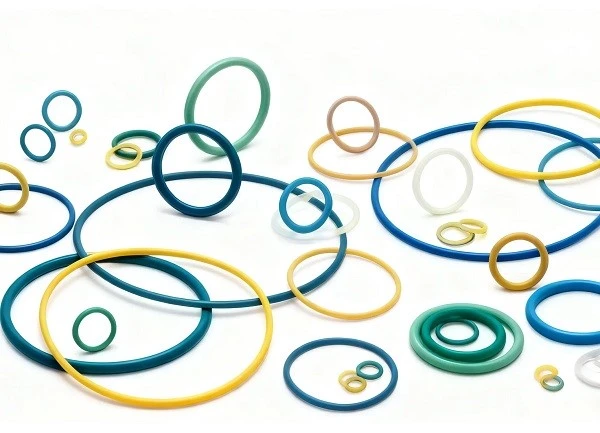
O-Ring Structure and Working Principle Explained
Let's start with the structure of the O-ring and then see how it works in different applications.
O-Ring Structure
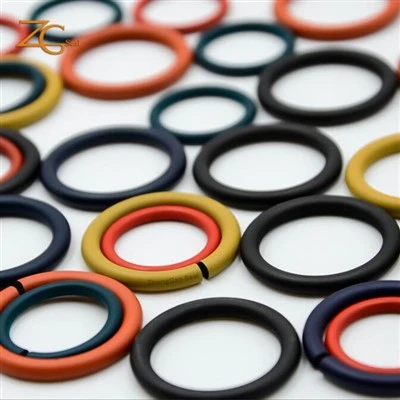
An O-ring is a ring-shaped seal, typically with a circular cross-section, made of elastic rubber materials such as nitrile rubber (NBR), fluororubber (Viton/FKM), and silicone. The O-ring is installed in a gland and compressed after assembly, forming a contact line with the mating surfaces, thus preventing fluid or gas leakage. While most O-rings have a circular cross-section, some special designs may use a non-circular cross-section to meet specific application requirements.
Static Sealing Mechanism
Static sealing is a continuous compression seal created by an O-ring on a fixed contact surface. When the O-ring is compressed between the groove and the mating surface, its elastic deformation fills the microscopic gaps on the surface. Because the contact pressure exceeds the internal fluid pressure of the system, an effective static seal is formed between the O-ring and the mating surface. It is widely used in applications on fixed contact surfaces such as pipe joints and flange connections.
Dynamic Sealing Mechanism
In dynamic sealing applications, such as pistons, rotating shafts, or sliding seals, there is relative movement between the O-ring and the mating surfaces. System pressure causes the O-ring to deform towards the low-pressure side, thereby enhancing the sealing force. However, this dynamic contact also generates friction and wear, thus requiring proper groove design and lubrication control to mitigate wear.
Pressure Self-Compensating Sealing Principle
Compared to other seals, the core advantage of O-rings lies in their pressure self-compensating characteristic, a comprehensive enhancement mechanism that balances static and dynamic sealing. When system pressure increases, the fluid pressure pushes the O-ring against the low-pressure sidewall of the groove, automatically enhancing the sealing effect. This "pressure self-compensating sealing" mechanism ensures that, within a certain range, the higher the system pressure, the better the sealing effect.
What Causes O-Rings to Fail?
Over time, O-rings may fail due to compression set, extrusion, chemical degradation, or spiral cracks that develop during installation. Understanding the causes of O-ring failure helps select more reliable sealing systems.
|
Failure Mode |
Description |
Solution |
|
Compression set |
Permanent deformation |
Select better elastomer, control compression ratio |
|
Extrusion |
O-ring squeezed into clearance gap |
Use backup ring |
|
Spiral failure |
Twisting during installation |
Proper lubrication and assembly |
|
Chemical attack |
Material degradation |
Choose resistant compound |
|
Hardening/cracking |
Heat aging |
Select suitable material and temperature rating |
Key Factors Determining O-ring Performance
To ensure a good seal, material selection, structural dimensions, and compatibility with operating conditions are all essential; any deviation in any of these can lead to seal failure.
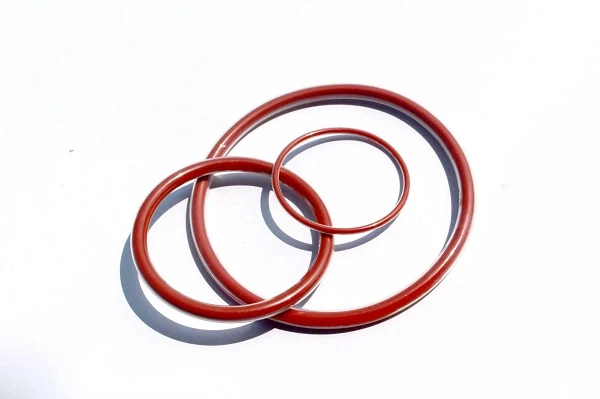
Material Selection
Different O-ring materials exhibit significant differences in temperature resistance, oil resistance, and chemical corrosion resistance. Precise selection based on the working medium and temperature range is crucial.
• Nitrile Butadiene Rubber (NBR): Excellent oil resistance, suitable for oily media such as hydraulic oil and fuel oil.
• Fluororubber (FKM): High temperature resistance and strong chemical corrosion resistance (such as strong acids and organic solvents), with an operating temperature range of -20℃ to 200℃. Commonly used in harsh environments such as aircraft engines and chemical equipment.
• Silicone Rubber (VMQ): Non-toxic and odorless, often used in food-grade formulations for food and medical devices, but with poor abrasion resistance, unsuitable for dynamic sealing applications.
• Ethylene Propylene Diene Monomer (EPDM): Outstanding weather resistance, able to resist ozone and ultraviolet radiation, commonly used in outdoor equipment and water pipe sealing applications.
Structure and Dimensions
Selecting appropriate dimensional parameters is crucial to ensure stable O-ring seals.
• Compression Ratio: This refers to the percentage of the O-ring's cross-section that is compressed. An insufficient compression ratio will fail to fill the gap; an excessive compression ratio will lead to material fatigue, permanent deformation, and shortened service life.
• Groove Design: The depth and width of the groove must match the O-ring size. The depth determines the compression amount, while the width must allow sufficient deformation space.
• Hardness: Soft O-rings offer good sealing performance and are suitable for low-pressure, smooth contact surfaces; hard O-rings have strong wear resistance and are suitable for high-pressure, dynamic friction scenarios.
Operating Condition Adaptability
After all, O-rings are used in specific equipment and must be adapted to the operating conditions.
• Temperature: Exceeding the material's temperature resistance range will cause the O-ring to harden and crack or soften and flow. The extreme temperatures of the working environment must be determined in advance.
• Pressure: O-rings can be used directly in low-pressure scenarios; high-pressure scenarios require a retainer ring; ultra-high-pressure scenarios require reinforced materials and special groove designs.
• Motion type: Static seals have lower requirements for O-ring wear resistance, while dynamic seals require priority to choose materials with strong wear resistance and use special grease to reduce friction.
Conclusion
Although O-rings have a simple structure, they play a crucial role in preventing leaks and improving system reliability. Understanding their working principle will help you select the right O-rings to achieve a good seal and extend equipment life.
Contact Zhonggao to get professional advice on O-ring selection and sealing design for your applications.